Minimalist and fine line tattoos: what they are, how long they last and myths
In this article I explain from my experience in the studio what minimalist tattoos and the fine line style are, how the fine needle works on the skin, what myths should be discarded about its durability and what basic routines help the line stay clear over time.
In this guide
- What is the fine line style and how it differs from a traditional tattoo
- How fine lines behave on the skin over the years
- Common myths about minimalist tattoos and fine line
- Initial ideas: flower tattoos, botanical tattoos and clean lines
- Areas of the body where the fine line is usually better preserved
- Essential tattoo care in the first three weeks
- What to be clear about before quoting your first fine line in Sabaneta or Medellín
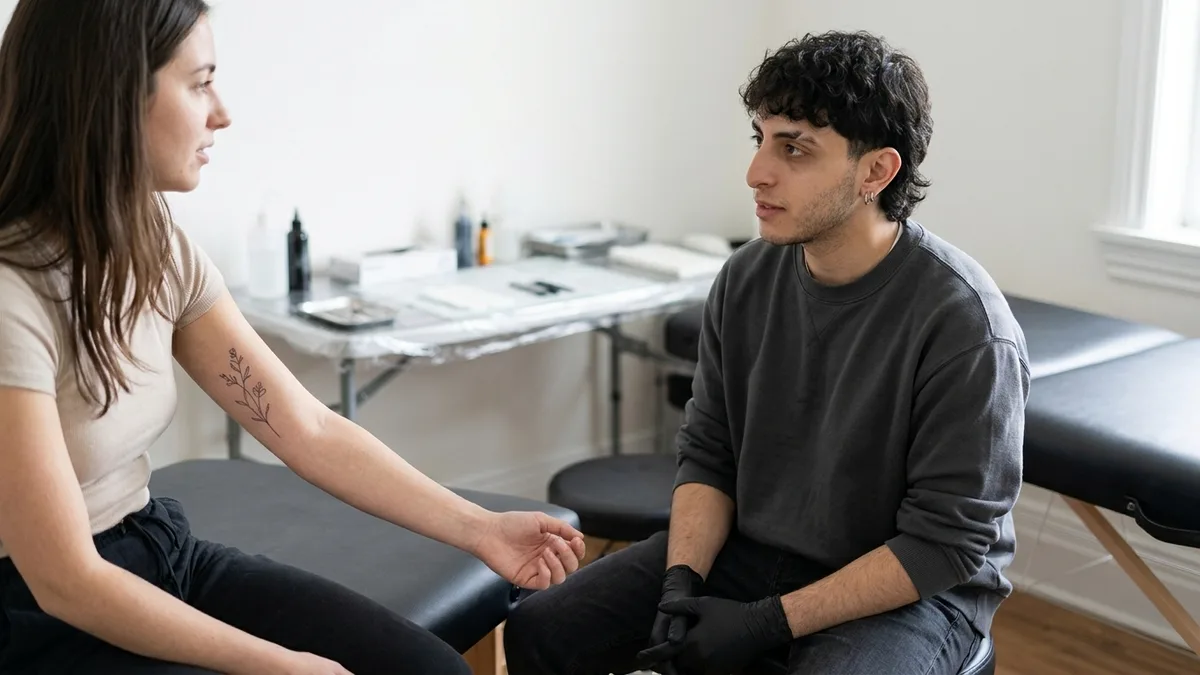
A common case in the studio: someone comes asking for a tiny tattoo thinking that that defines the style. In reality, a clean line or a botanical branch can be a fine line without having to be tiny.
What is the fine line style and how it differs from a traditional tattoo
Fine line is a technique focused on thin, clean and precise lines, where the prominence is given to the line and not large masses of black ink. Unlike traditional tattoos, which usually rely on thick contours and very marked shadows, here the drawing breathes more on the skin.
Many people confuse three different things: the small size, the aesthetic approach of minimalist tattoos and the fine line technique. You can make a minimalist piece with medium lines, or a medium design worked completely in fine lines. If you want to see real examples of this approach, you can check out my gallery of fine line and minimalist.
In my studio in Sabaneta I also work blackwork tattoos, which is my main specialty, and botanical pieces. Seeing the differences between techniques helps you choose clearly before scheduling:
| Style | Stroke thickness | Contrast level | Recommended areas | Long-term reading |
|---|---|---|---|---|
| Fine line | Very thin and precise | Low to medium, with focus on the line | Forearm, arm, back, leg | Good if there is space between the lines and good care |
| Botanical in fine line | Slim with organic details | Medium, combining contour and soft textures | Forearm, ribs, calf, arm | High when the size allows the leaves and petals to be separated |
| Blackwork | Medium to thick with solid fillings | High, based on deep black | Almost any large area of the body | Very high due to the marked contrast of solid black |
How fine lines behave on the skin over the years
All tattoo ink changes a little over time because the skin is a living organ that renews, stretches and receives sun. Over the years, any line tends to settle and expand slightly, and in the fine line this process is more noticeable because the line starts off very thin.
Whether a fine line ages well depends on three specific factors: the technique when applying the ink to the appropriate depth, the separation between the strokes of the design and the care you give it after leaving the studio. If a line is too superficial, it can be lost during healing; If it is too deep, it tends to open more than necessary.
If you like a design with lines very close to each other, give it a couple of extra centimeters. That margin makes the difference between a tattoo that reads cleanly in five years and one where the strokes end up joining together.
That's why I always check the proportion of each idea before tattooing it. Adjusting the size in time avoids unnecessary retouching and allows the drawing to retain its original shape.
Common myths about minimalist tattoos and fine line
Several repeated ideas circulate around this style on social networks that confuse those looking for their first tattoo. Clarifying them avoids unrealistic expectations before sitting on the table.
- 01
They fade in a few months: a fine line well applied to the correct layer of skin is permanent. It may soften a little as it heals, but it does not disappear if it is well worked and well cared for.
- 02
The smaller, the better it looks: reducing a drawing full of details too much causes the lines to be tight and lose definition over time.
- 03
They do not need special care: as they are fine lines, any carelessness with the sun, strong rubbing or tearing off the scab is noticeable much faster than in a thick piece.
- 04
They serve to cover any previous tattoo: the fine line does not have the ink density necessary to cover an old or dark design.
Separating these myths from reality helps you decide if minimalist tattoos fit with what you hope to see on your skin in several years.
Initial ideas: flower tattoos, botanical tattoos and clean lines
If you are starting to explore ideas, simple natural and geometric motifs usually work very well in fine lines because they take advantage of the fluidity of the line without overloading the skin. The flower tattoos and botanical tattoos are the most frequent requests in the studio.
An olive branch, a long-stemmed flower, loose leaves or an organic composition that follows the curve of the arm allows you to work on delicate details with good space between lines. The important thing is that the petals and ribs have enough air so as not to close over the years.
Continuous lines, short words with clean typography, simple symbols or small linear compositions also work very well. When you have a reference saved, see if the design depends on micro details that are impossible to hold in two centimeters or if it can be adapted to a comfortable scale for your body.
Areas of the body where the fine line is usually better preserved
The area you choose influences as much as the design. Areas with more stable skin, less daily friction and less constant sun exposure tend to retain the sharpness of the fine line for longer.
The inner forearm, outer arm, back, thigh and calf are very noble locations for this style. The skin there has an even thickness and does not suffer the continuous friction of other areas.
On the other hand, fingers, palms, sides of the hands and feet have faster cell renewal and rub against water, clothing or shoes all day long. At these points the fine ink usually wears off unevenly. If you want a clean line that remains stable, it is advisable to prioritize areas with little friction and protect them well from the sun.
Essential tattoo care in the first three weeks
Healing defines a huge part of the final result in a fine line. In my guide tattoo care I explain the complete step by step, but here you have the essentials for the first weeks.
During the first approximately 14 days, wash the area with neutral soap, dry gently and apply a light layer of blue Lubriderm cream. The scab should fall off on its own: never scratch or tear it off, because you can take away some of the ink from the fine line.
During the first 3 weeks you should avoid direct sun and any stagnant water such as swimming pools, sea, jacuzzis or bathtubs. Starting from the third week, when the skin has closed its initial phase, the maintenance stage begins by applying 50+ sunscreen every time the area is exposed.
Taking care of hygiene and observing how the skin evolves is essential. so much Mayo Clinic like the FDA remember that tattooing involves opening the skin barrier, so keeping the area clean, avoiding risky practices and consulting a health professional if there are signs of infection or abnormal reaction is the responsible way to protect your skin.
What to be clear about before quoting your first fine line in Sabaneta or Medellín
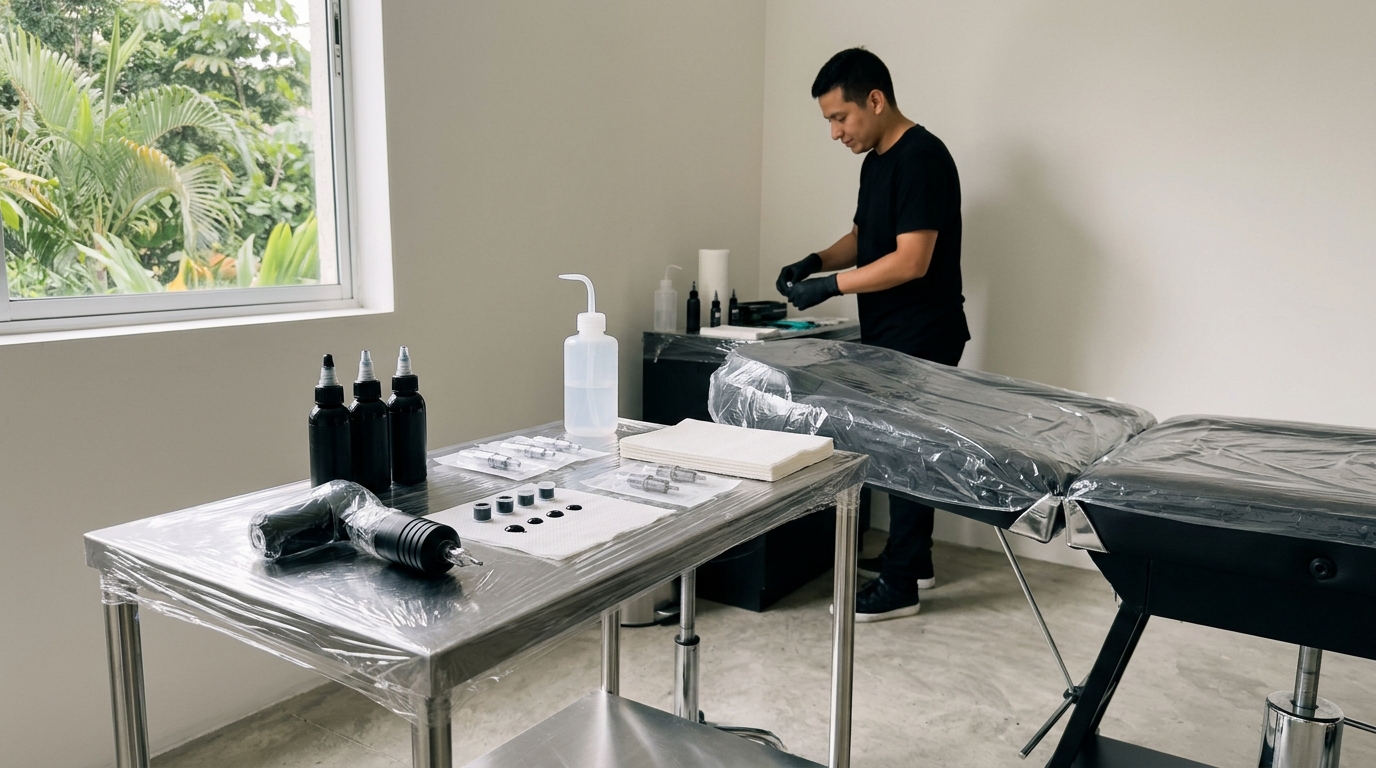
In Negas Tattoo I work in a private studio in Sabaneta, Antioquia, within the metropolitan area of Medellín. I attend only by appointment and in person, one person at a time, to dedicate calm and precision to each session. If you come from another nearby municipality, on my page medellin tattoos and Sabaneta tattoos you can see how care works in the area.
My specialties are blackwork, botanical and fine line. Please note that I do not cover up previous tattoos. Small pieces start at $180,000 COP, and you can get an approximate investment in the tattoo quoter depending on the idea, size and location.
Once you have that reference, the final value is always confirmed by WhatsApp from the contact page. To reserve your date, a payment of $50,000 COP is made to confirm the appointment; This subscription is non-refundable, but you can reschedule by giving at least 48 hours' notice. If you are also curious about how to prepare for the day of your session, you can read my article on how to arrive ready for your appointment.
Review the complete guide at https://Negas.tattoo/cuidados, calculate your approximate investment at https://Negas.tattoo/cotizar and write to me by WhatsApp from https://Negas.tattoo/contacto to confirm the final value and schedule your appointment with the payment of $50,000 COP.
Frequently asked questions
Does a fine line tattoo always fade quickly?
No. A well-applied fine line tattoo at the correct depth is permanent. Over the years the line may soften a little, as happens with any tattoo, but it does not disappear if the technique was adequate and if you comply with the initial care and 50+ sunscreen from the third week.
Does every minimalist tattoo have to be tiny?
It doesn't have to be tiny. The minimalist approach refers to visual cleanliness, the measured use of elements and the absence of overload in the design. You can wear a medium-sized minimalist piece on your arm or back that looks light and ages much better than a tight draw.
Do fine line flower tattoos lose detail if they are very small?
Yes, when petals, leaves and stem lines are too close together, the natural expansion of the ink over the years can cause them to clump together. Giving flower tattoos a comfortable size allows each line to have air and keep its clean shape longer.
Does a fine line hurt less than a blackwork?
The discomfort depends a lot on the area of the body and your personal sensitivity. Fine line usually requires less solid ink saturation than blackwork, but the needle still works on the skin. Resting well, eating before the appointment, and arriving calm helps more than assuming it won't hurt.
How long should I take care of a fine line with neutral soap and blue Lubriderm?
The initial healing phase lasts about 14 days, washing with neutral soap, applying Lubriderm blue and letting the scab fall off on its own. Additionally, avoid direct sun and stagnant water for 3 weeks, and from the third week onwards, incorporate 50+ sunscreen as a maintenance habit.
Can I use fine line to cover an old tattoo?
It is not recommended, because the fine line does not have the coverage or density necessary to hide old ink. Additionally, in my private studio at Sabaneta I do not cover; I work only on skin free of previous tattoos in blackwork, botanical and fine line styles.